
Google Ads vs Meta Ads: Which One Generates Better Leads?
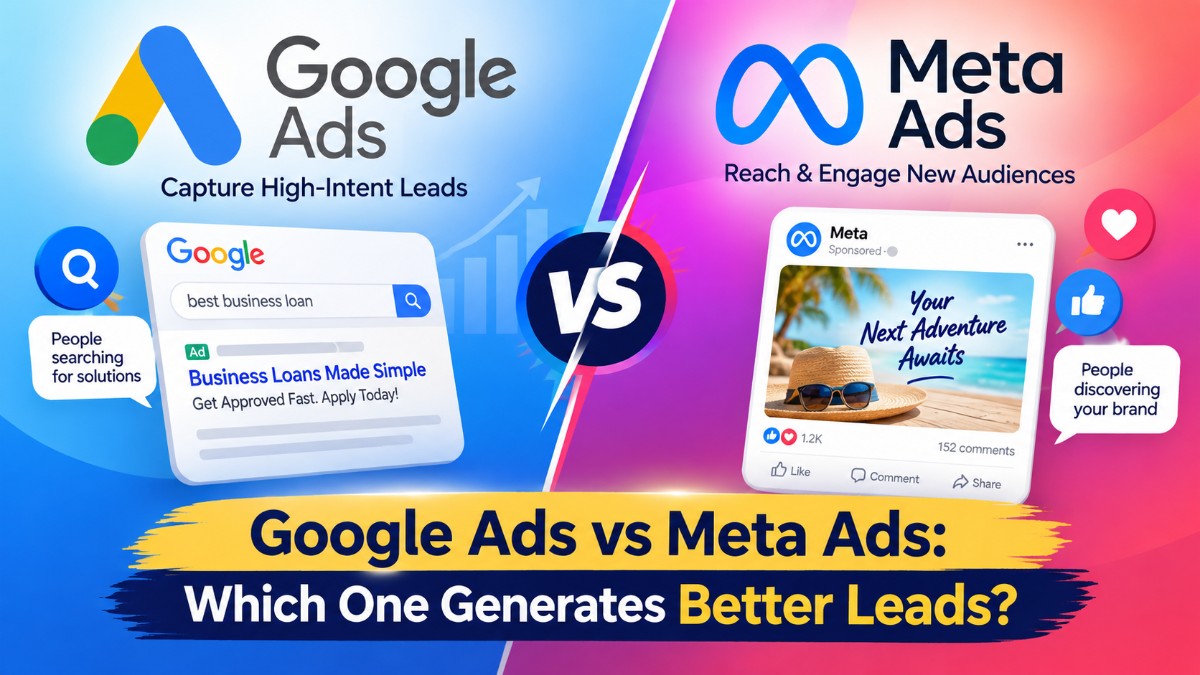
Every business owner running paid advertising eventually asks the same question: should the budget go to Google Ads, Meta Ads, or both? It’s one of the most common debates in digital marketing, and the honest answer is that there isn’t a universal winner. The right platform depends on what you’re selling, how your customers search for it, and what “a good lead” actually looks like for your business.
This article breaks down how each platform generates leads, where each one tends to outperform the other, and how to decide which is the smarter starting point for your budget — especially if you’re a business in Australia weighing up where to spend your first advertising dollars.
Understanding the Core Difference: Intent vs Interruption
The most important distinction between Google Ads and Meta Ads isn’t cost or targeting options — it’s intent.
Google Ads works on search intent. Someone types “emergency plumber Parramatta” or “best car insurance Australia” into Google because they already have a need and are actively looking for a solution right now. Your ad shows up at the exact moment they’re ready to act. This is why Google Ads is often described as capturing demand rather than creating it.
Meta Ads (Facebook and Instagram) works differently. It’s an interruption-based platform. People aren’t searching for anything — they’re scrolling through photos of friends, reels, or news. Your ad has to stop them mid-scroll and create interest in something they weren’t necessarily thinking about. This is why Meta Ads is often described as generating demand rather than capturing it.
Neither approach is better in the abstract. But this single difference explains almost everything else about how leads behave on each platform — their volume, their cost, their quality, and how ready they are to buy.
Lead Quality: Warm Intent vs Broader Reach
Because Google Ads leads come from active searches, they tend to arrive further along in the buying journey. Someone searching “solar panel installation quote Brisbane” already knows they want solar panels — they just need to choose a provider. That makes Google leads, on average, warmer and more sales-ready.
Meta Ads leads can be excellent too, but they usually sit earlier in the decision process. Someone who clicks a Facebook ad for solar panels might be mildly curious rather than ready to book an installation. This doesn’t make the lead worthless — it means your follow-up process needs to do more of the convincing, since the ad interrupted them rather than answered an existing need.
For industries with high-intent, high-value searches — home services, legal, medical, finance, real estate — Google Ads often produces leads that convert to sales faster and at a higher rate. For industries that rely on visual appeal, impulse decisions, or building awareness before a purchase — fashion, beauty, home décor, hospitality, consumer products — Meta Ads frequently wins on both volume and cost-effectiveness.
Cost Per Lead: It’s Not a Simple Comparison
A lot of businesses compare Google and Meta purely on cost per lead, but this comparison misses the point unless you also account for lead quality and sales conversion.
Google Ads costs per click are generally higher, particularly in competitive industries like legal services, insurance, or finance, where cost per click can run into double digits. But because the person is already searching with intent, the percentage of leads that go on to become paying customers is usually higher. A more expensive lead that converts is often cheaper, in the end, than a cheap lead that goes nowhere.
Meta Ads typically produce a lower cost per click and can generate a higher volume of leads for the same budget. However, because the audience wasn’t actively searching, a larger share of those leads may not be ready to buy immediately, or may not be a strong fit at all. This means the real cost per qualified lead can end up closer to Google’s than the initial cost per click suggests.
The only reliable way to know which platform is cheaper for your business is to track cost per qualified lead and cost per sale — not just cost per click or cost per form fill.
Speed to Results
Google Ads can start generating leads almost immediately once campaigns are live, assuming your keywords, ad copy, and landing page are aligned with what people are searching for. There’s little need for the algorithm to “learn” who your customer is — the searcher has already told you their intent through the keyword they typed.
Meta Ads usually need a learning phase. The algorithm needs time and data (generally a minimum ad spend and a set number of conversions) to figure out who responds well to your ad and refine targeting accordingly. This means Meta campaigns often improve meaningfully after the first one to two weeks, as the system optimises delivery.
If you need leads urgently — for example, filling appointment slots this week — Google Ads is usually the faster lever to pull. If you’re building a longer-term customer acquisition engine and can allow a short optimisation window, Meta Ads can become highly efficient once it settles.
Targeting: Keywords vs Audiences
Google Ads targets based on what people type. This makes it extremely effective for capturing existing, specific demand — but only if that demand is being expressed through search in the first place. If nobody is searching for what you offer, Google Ads has nothing to capture.
Meta Ads targets based on who people are — their demographics, interests, behaviours, and increasingly, lookalike audiences based on your existing customers. This makes Meta a stronger platform for introducing a product or service to people who might want it but haven’t thought to search for it yet, or for retargeting people who’ve already shown interest in your business (website visitors, past leads, email lists).
This is one of the most overlooked strengths of Meta Ads: retargeting. Someone who visited your website but didn’t enquire is a warm audience Meta can re-engage with tailored ads, often at a lower cost than acquiring a completely new visitor.
Which Industries Tend to Favour Which Platform
While every business is different, some patterns are consistent across the Australian market:
Google Ads tends to perform strongly for tradespeople and emergency services, legal and accounting firms, medical and allied health practices, financial services and insurance, and any business where customers actively search when the need arises.
Meta Ads tends to perform strongly for e-commerce and retail brands, beauty and aesthetics clinics, hospitality and events, home renovation and interior design, and businesses that rely on visual storytelling to spark interest.
Many businesses that sit in between — real estate, education, fitness, and B2B services — often see the best results running both platforms simultaneously, using Google to capture people actively comparing options and Meta to build awareness and stay in front of people earlier in their decision process.
Why the Best Strategy Is Often Both, Not Either/Or
Framing this as a strict either/or decision can actually hold a business back. In practice, Google and Meta serve different stages of the same customer journey, and the strongest lead generation strategies typically use both together.
A common, effective structure looks like this: Meta Ads build awareness and capture attention from people who fit your ideal customer profile but aren’t actively searching yet. Website visitors and engaged users are then retargeted with Meta ads that push them further down the funnel. Meanwhile, Google Ads captures the portion of your market that is actively searching for your service right now, converting existing demand into leads. The two channels reinforce each other — someone who sees your brand on Instagram is more likely to click your Google ad later because your name already looks familiar.
Businesses with limited budgets often need to choose one platform to start, and that’s a reasonable approach — but as budget allows, testing both usually reveals opportunities that a single-channel strategy would miss entirely.
How to Actually Measure Which Is Working Better for You
Whichever platform you run, the comparison is only meaningful if your tracking is set up properly. At a minimum, you should be tracking cost per lead by source, lead-to-sale conversion rate by source, cost per sale (not just cost per lead), and lead quality feedback from your sales team, since raw numbers rarely tell the full story.
Without this level of tracking, it’s easy to draw the wrong conclusion — for example, assuming Meta is “cheaper” simply because the cost per lead is lower, without realising that Google leads are converting to paying customers at three times the rate.
Making the Decision for Your Business
If you can only run one platform right now, start by asking whether your customers actively search for what you offer when they need it. If yes — trades, healthcare, legal, finance, emergency services — Google Ads is usually the stronger starting point, because you’re capturing demand that already exists.
If your product or service is something people don’t typically search for until they’ve already seen and liked it — fashion, beauty, home products, hospitality — Meta Ads is usually the better entry point, because you need to create the interest before you can capture it.
And if your business sits somewhere in between, or if budget allows for testing both, running Google and Meta together — with proper tracking in place to see which leads actually convert to revenue — will almost always outperform relying on either platform alone.
The real answer to “Google Ads vs Meta Ads” isn’t about which platform is objectively better. It’s about matching the platform to how your specific customers behave, then measuring performance by revenue, not just lead volume. That shift in thinking is usually what separates advertising that generates real growth from advertising that just generates numbers on a report.