
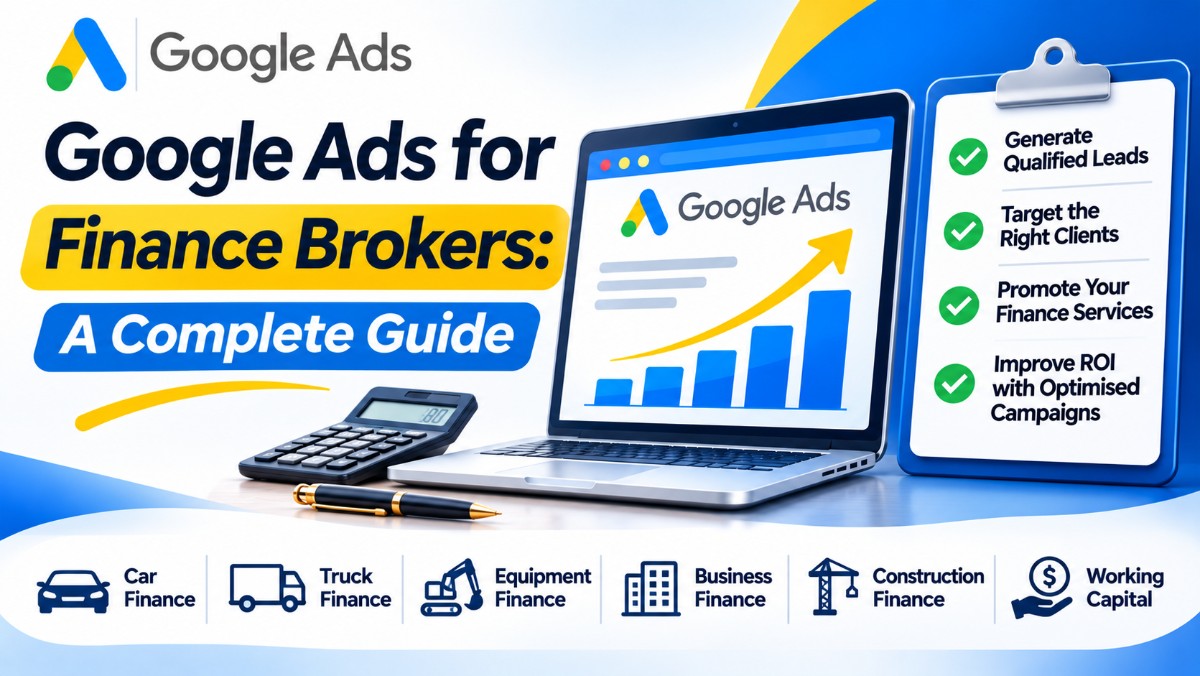
Google Ads for Finance Brokers: A Complete Guide
When a business needs a new truck, a fit-out loan, or working capital to cover a slow quarter, the owner rarely walks into a bank first. Increasingly, they search. “Equipment finance broker,” “business loan for a small business,” “truck finance options,” and “invoice finance” are all searches typed by people with a pressing need and a purchase or deadline attached.
That makes Google Ads a natural fit for finance brokers who arrange asset finance, equipment finance, business loans, car and novated finance, and commercial lending. Intent is strong, deal values are often large, and a single client can return again and again as their business grows.
This is not the same as advertising for home loans. Commercial and asset finance has different customers, longer and more varied sales cycles, different keywords, and its own regulatory considerations. This guide explains how finance brokers, particularly in Australia, can use Google Ads effectively: choosing the right niche, structuring campaigns, selecting keywords, writing compliant ads, building landing pages, managing costs, and measuring results through to funded deals. It is general information and not legal, compliance, or financial advice.
What “Finance Broker” Covers
The term spans several services, and each behaves differently in advertising.
Asset and equipment finance. Funding for vehicles, machinery, tools, technology, and other business assets. Buyers are often tradies, transport operators, farmers, healthcare practices, and manufacturers.
Business loans and working capital. Unsecured or secured loans for cash flow, expansion, stock, or refurbishment.
Invoice and trade finance. Funding against unpaid invoices or to support purchasing, used by businesses with long payment terms.
Commercial property finance. Loans for investment or owner-occupied commercial property.
Vehicle and consumer finance. Car loans, novated leases, and personal finance for individuals.
Decide which of these you serve best. Spreading across all of them dilutes your messaging and budget, while a clear focus, such as “equipment finance for tradies” or “truck and transport finance,” gives you sharper ads, better landing pages, and often less competition.
Why Google Ads Suits Finance Brokers
Search intent is the main reason. Someone typing “excavator finance” or “business loan broker” has a specific need. Unlike social media, where you interrupt people, search lets you answer a question at the moment it is asked.
The economics also help. Finance brokers earn commission or fees on funded deals, and commercial deals can be substantial. Business clients tend to repeat, refinance, and refer others, so lifetime value can be high.
The challenges are cost and competition. Finance keywords can be expensive, banks and fintech lenders advertise aggressively, and online lenders promise fast approvals. Brokers win by emphasising what they offer that a single lender cannot: access to multiple lenders, tailored structuring, and help through the process.
Pick a Niche and Build Around It
The best results usually come from specialisation. Consider segmenting by the asset, the industry, or the type of borrower.
By asset. Trucks and trailers, construction equipment, agricultural machinery, medical equipment, commercial vehicles, hospitality fit-outs, and technology.
By industry. Tradies, transport, agriculture, healthcare, hospitality, and manufacturing. Industry knowledge builds trust, and searches for industry-specific finance are often less contested.
By borrower profile. New businesses, self-employed applicants, businesses with credit challenges, and established firms seeking to expand. Brokers who can arrange finance for harder-to-place borrowers often face lower competition and higher perceived value.
By funding type. Chattel mortgages, finance leases, hire purchase, operating leases, and business lines of credit.
Each niche can have its own campaign, keywords, ads, and landing page, so that visitors see exactly what they searched for.
Campaign Types
Search campaigns
The foundation of finance advertising. Text ads appear when someone searches a relevant phrase. Structure campaigns by asset, industry, or product, for example “truck finance,” “excavator finance,” and “business loans,” so that each has aligned keywords, ads, and landing pages.
Performance Max
It can generate leads across Google’s network, but offers limited control and can chase low-quality conversions if tracking is weak. Test it cautiously once your search campaigns and conversion data are solid.
Remarketing
Business finance decisions can take days or weeks, with comparison, supplier negotiations, and approvals along the way. Remarketing keeps you visible to visitors who did not enquire at first.
Brand and local
Protect your name with a small brand campaign. If you work with local businesses or a defined region, optimise your Google Business Profile and gather reviews, since owners often check these before contacting a broker.
Keywords: Aim at Buyers, Exclude the Noise
Finance keywords can be expensive, so precision matters.
Target specific asset and product terms. Phrases like “truck finance broker,” “equipment finance for small business,” “chattel mortgage,” “business loan broker [city],” and “invoice finance” signal real need. Add asset names that match your niche.
Include “broker.” Searchers using it understand the value of a broker and tend to be well suited to your service.
Think about timing and urgency. Terms like “fast business loan” or “same day finance” attract urgent buyers but also attract the poorest-quality borrowers and the most aggressive competitors. Use them carefully and qualify leads well.
Use match types deliberately. Phrase and exact match give control. Broad match can discover new queries but wastes money quickly in a costly category without strong negatives and clean conversion data.
Build a long negative keyword list. Typical negatives include “jobs,” “careers,” “salary,” “course,” “licence,” “how to become a finance broker,” “calculator” (if you do not want it), “login,” “customer service,” “complaint,” “free,” “grants” (unless relevant), “personal loan” (if you serve only business), “payday,” and lender names for existing customers. Review the search terms report weekly.
Geographic focus. Many finance brokers work nationally, but local searches often convert better. Match location targeting to where you can actually serve clients.
Writing Ads That Work and Comply
Finance advertising must be persuasive and accurate.
Say what makes you different. Access to multiple lenders, specialist industry knowledge, quick turnaround, and support with paperwork are real advantages. Make sure each claim is true for your business.
Be specific. “Truck finance for owner-operators” is stronger than “Finance solutions for you.”
Be careful with rates and speed. Quoting interest rates triggers additional requirements, and promising approval times or outcomes can mislead. Avoid “guaranteed approval,” “lowest rates,” and similar claims unless they are accurate and substantiated. Approval is never guaranteed.
Use ad assets. Sitelinks, call extensions, callouts, and structured snippets expand your ads. Phone calls are valuable because many business owners prefer to talk through their situation.
Test variations. Try different angles, such as speed, specialist experience, or lender access, and keep what performs.
Compliance and Regulation
Finance broking is regulated, and the details depend on what you arrange and for whom.
Credit licensing. Arranging credit for consumers generally requires an Australian Credit Licence or being a credit representative. Many business and commercial finance arrangements fall outside consumer credit regulation, but the line depends on the purpose of the loan and the borrower, and some arrangements, such as loans to sole traders for mixed purposes or for personal use, can fall under consumer credit rules. Work out which rules apply to each product you broker.
Financial services licensing. Some products, such as certain investment or deposit products, can bring Australian Financial Services Licence requirements. Check your licence coverage.
Misleading or deceptive conduct. The Australian Consumer Law and ASIC Act apply to advertising of financial services. Claims about rates, approvals, savings, and lender panels must be accurate.
Disclosure of commissions and fees. Be clear about how you are paid, and meet any disclosure requirements.
Aggregator and licensee rules. If you operate under an aggregator or licensee, follow its advertising approval process.
Google’s policies. Google has financial services advertising policies and, in some regions including Australia, verification requirements for certain advertisers. Check current requirements and complete any verification before launching. Non-compliant ads can be disapproved or accounts suspended. Google also has specific policies on personal loans and short-term, high-cost lending, so make sure your campaigns do not fall into restricted categories.
Privacy. Enquiry forms collect personal and financial details. Maintain a clear privacy policy and secure data handling. Australian privacy law may apply, and credit-related information is subject to additional rules.
Because the answers depend on your products, structure, and licences, check with your compliance officer, licensee, or a lawyer before launching. This article is general information, not legal advice.
Landing Pages That Convert
With expensive clicks, the landing page is where return on investment is decided.
Match the page to the ad. If the ad is for excavator finance, the page should speak about excavator finance, address common concerns, and show how the process works. Use a short form: name, business name, phone, email, and perhaps the asset type and approximate amount. A few qualifying fields help filter leads, but too many reduce submissions.
Build trust with your credentials, licence details where required, client reviews, lender panel information (if permitted), and examples of finance you have arranged, without disclosing client details. Explain the process in plain steps: enquiry, assessment, lender selection, approval, and settlement, with realistic timeframes.
Offer a low-pressure first step such as a no-obligation finance check, a callback within an hour, or a short guide on choosing between a chattel mortgage and a lease. Make the phone number prominent and tappable, and make sure the page is fast and works well on mobile.
Budget, Bidding, and Cost Control
Plan from the economics of your business.
Estimate the average commission or fee per funded deal, the percentage of leads that fund, and the repeat value of clients. From those, work out how much you can afford to pay per lead and per funded deal. Recognise that conversion rates in finance can be modest, because many enquiries do not qualify or proceed.
Start with a controlled budget on your strongest niches. Use manual or enhanced bidding while learning, and move to automated strategies such as target CPA once you have enough conversion data. Schedule ads around hours you can answer, and use location targeting to focus on areas you serve. Avoid overlap between campaigns that compete with each other.
Tracking and Lead Quality
Leads are cheap to count and hard to value, so measure beyond the form.
Track phone calls from ads, calls from your website, and form submissions. Record every lead in a CRM with its source, then follow it through the pipeline: contacted, qualified, application submitted, approved, and funded. Where possible, import offline conversions, such as “qualified lead” or “funded,” back into Google Ads so its automation optimises for real deals.
Key numbers include cost per lead, qualified-lead rate, application rate, cost per funded deal, and return on ad spend. Speed matters: business owners often approach several brokers, and the one who responds first with a clear, knowledgeable conversation tends to win. Document a fast follow-up process, and make sure calls are answered or returned quickly.
Support Your Ads With the Rest of Your Presence
Google Ads works better when your reputation backs it up. A complete Google Business Profile with genuine reviews builds trust. Content on your website, such as guides to chattel mortgages versus leases, tax considerations to discuss with an accountant, and how lenders assess business applications, helps with organic search and credibility. Referral relationships with accountants, equipment dealers, and bookkeepers can complement paid advertising, and follow-up emails keep you in front of leads who are not ready yet.
Common Mistakes Finance Brokers Make
Advertising too broadly across every type of finance. Competing for the most expensive generic terms against banks and big lenders. Skipping negative keywords and paying for job seekers, “how to become a broker” searches, and unrelated personal loan queries. Sending clicks to a homepage. Making claims about rates, speed, or approval that cannot be supported. Ignoring Google’s financial services verification. Judging success by leads and not funded deals. Slow response to enquiries. And stopping before the sales cycle shows the real return.
Should You Hire an Agency?
Finance advertising mixes high costs with regulatory risk, so specialist help can pay off. Look for experience in financial services, ask how the agency handles compliance and verification, confirm that you own the ad account, and require reporting that links spend to qualified leads and funded deals. Build your licensee’s or compliance team’s approval into the process before ads go live.
A Simple Starting Plan
Choose one niche you serve well, such as a specific asset or industry. Confirm your licensing position and complete any required Google verification. Build a tightly themed search campaign with phrase and exact match keywords and a long negative list. Write specific, compliant ads, and create a dedicated landing page with a short form and clear credentials. Set up call and form tracking and connect it to your CRM. Run for four to six weeks, review search terms and lead quality, and refine. When cost per funded deal is acceptable, expand to additional niches or regions.
Final Thoughts
Google Ads can give finance brokers a steady stream of business owners and individuals who are actively seeking funding. The brokers who do best specialise in a niche, bid on specific, high-intent terms, keep negatives tight, send traffic to focused and credible landing pages, respond quickly, and track results through to funded deals.
Combine that with careful attention to licensing, advertising rules, and platform verification, and a patient approach to testing, and Google Ads becomes a dependable source of clients who value a broker’s advice and return when they need finance again.